

Buying your first home is a major decision. Beyond choosing the right size or design, you need to understand the location, developer, project approvals, apartment specifications, total cost, and long-term suitability of the property.
For buyers considering Zirakpur and the Tricity region, this first-time home buyer guide highlights the key factors worth evaluating before making a decision. The objective is simple: help you compare properties based on information that matters, rather than making a decision based only on advertisements, amenities, or initial impressions.
1. Start With Your Actual Home-Buying Requirements
Before visiting projects, define what you need from your home.
Consider the number of bedrooms, preferred carpet area, parking requirements, family size, daily commute, and whether the property is intended for self-use or another long-term purpose.
For many families, a home is also about the surrounding environment. Access to everyday facilities, road connectivity, open spaces, and the overall planning of the community can influence how practical the property is over time.
Having these requirements clear makes it easier to compare different residential projects objectively.
2. Evaluate the Location, Not Just the Project
A well-designed home still needs to be in a location that works for your daily life.
When evaluating property in Zirakpur, look at its relationship with Chandigarh, Mohali, Panchkula and other important parts of the Tricity. Also consider your regular routes, nearby services, road access and the character of the surrounding area.
Do not rely only on a map or brochure. Visit the location yourself and assess:
- Road access and everyday connectivity
- Traffic conditions at different times
- Nearby schools, healthcare and essential services
- Existing development around the project
- Noise, access and surrounding activity
- How the location fits your regular commute
Location should be assessed as part of the complete property decision, rather than as a standalone selling point.
3. Understand the Developer’s Experience
The developer is an important part of your home-buying decision, particularly when purchasing in a developing residential market.
Look beyond promotional material and understand the company’s history, completed developments and approach to construction and execution.
Prem Bansal Group began its journey in 1979 with a focus on land aggregation and planned development in North India. Over the decades, the Group expanded into residential and commercial development and continues to focus on residential communities and mid- to high-rise developments in Zirakpur and the wider Tricity region. You can review the people behind these decisions on the Group’s leadership page.
PBG’s stated development philosophy is based on long-term land and capital discipline, measured growth, execution, construction quality, community-first planning and experience across real estate cycles.
For a first-time buyer, understanding this background can provide useful context when comparing developers.
4. Check Project Registration and Relevant Documents
Documentation should never be treated as a formality.
For a residential project in Punjab, buyers can use the official Punjab RERA portal to search registered projects and review available project information.
Depending on the project and transaction, buyers should review the applicable documents and seek professional legal advice where necessary. These may include:
- RERA registration details
- Title and ownership-related documents
- Approved plans and project permissions
- Agreement for sale
- Apartment specifications
- Carpet area details
- Applicable payment terms and charges
The exact documents required can vary depending on the property and transaction. An independent property lawyer can help you understand the legal documents before signing.
5. Understand Carpet Area and Apartment Specifications
The size mentioned in a property advertisement does not tell you everything about the home.
Pay attention to the carpet area, layout, room dimensions, balconies, utility spaces and other areas specifically identified in the project documentation.
Under RERA, carpet area has a defined meaning and refers to the net usable floor area of an apartment, subject to the exclusions specified in the Act.
When comparing homes, look at the complete floor plan rather than comparing only headline square footage.
Ask:
- What is the RERA carpet area?
- How is the available space distributed?
- Are the rooms practical for your family’s needs?
- How much natural light and ventilation does the layout provide?
- What are the balcony and other exclusive areas?
A thoughtful floor plan can matter as much as the overall size.
6. Look at the Community Around Your Home
A home is part of a larger living environment.
For families considering a residential development, examine how the project is planned as a community. Open areas, internal movement, common spaces, everyday facilities and the relationship between residential and other uses can influence daily living.
PBG’s current portfolio spans different community formats. Sapphire Court, a delivered development, offers 3 BHK independent floors within a planned residential setting. Swastik Vihar is a large-format plotted township where infrastructure was developed by PBG, with construction carried out independently by individual plot owners over time. The Suncrest, currently under planning, is positioned as an upcoming high-rise residential development focused on elevated living and open, thoughtful design. As with any project still in the planning or regulatory stage, buyers should confirm final configurations, amenities and delivery timelines directly with the developer before relying on them.
The right question is not simply, “How many amenities are there?”
Instead, ask whether the overall planning suits the way you and your family expect to live, and whether the project’s current stage (delivered, under construction, or upcoming) matches your timeline.
7. Review the Total Cost, Not Just the Advertised Price
The quoted property price is only one part of the financial commitment.
Before booking, request a clear cost sheet and understand which charges apply to your purchase. Depending on the transaction and applicable rules, these may include statutory charges, registration-related expenses, taxes, parking or other project-specific charges.
Do not make a decision based only on the lowest quoted base price.
A better comparison is the total cost of acquiring the home and the payment schedule associated with it. If you are using a home loan, discuss your financing capacity and repayment obligations directly with your lender.
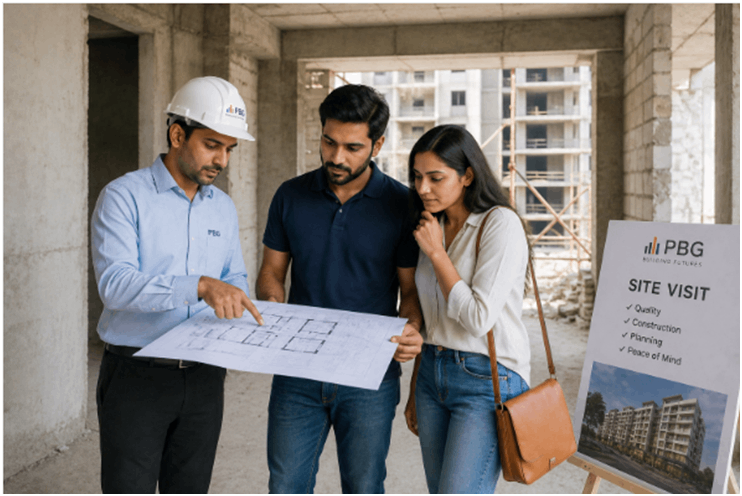
8. Visit the Project Before Making a Decision
A site visit gives you information that a brochure or online listing cannot fully provide.
Visit the project location and, where available, review the relevant sample apartment, plans and project information. Observe the approach road, surrounding development and the relationship between the project and nearby areas.
During your visit, consider:
- Actual approach and road conditions
- Surrounding development
- Site planning and available open areas
- Apartment orientation and views
- Construction progress, where applicable
- Common areas and project access
Take your time. A first visit should help you identify questions for the next stage rather than immediately push you toward a decision.
9. Compare Projects on Consistent Parameters
Comparing properties becomes easier when you use the same criteria for each project.
Create a simple comparison covering:
| Factor | What to Compare |
| Location | Connectivity and surrounding development |
| Developer | Experience and delivered developments |
| Legal | RERA and relevant documentation |
| Home | Carpet area and floor plan |
| Community | Planning, open spaces and facilities |
| Cost | Total applicable cost and payment schedule |
| Construction | Specifications and execution stage |
| Suitability | Fit for your family’s needs |
This approach keeps the decision focused on facts rather than individual marketing claims.
10. Think Beyond the Immediate Purchase
A first home is often a long-term decision. That does not mean every property will automatically appreciate or that one location will always outperform another. Instead, consider whether the home and its location make sense for your intended period of ownership.
Look at the quality of the development, surrounding growth, connectivity, community planning and the developer’s approach to long-term development, as reflected in its stated philosophy and organisational values.
PBG’s primary development focus is the Zirakpur-Tricity region, where the Group states that it continues to identify and develop residential communities aligned with long-term urban growth patterns.
Questions First-Time Home Buyers Should Ask
Before booking a property, consider asking:
How do I choose a home in Zirakpur? Start with your requirements, then compare location, developer experience, documentation, apartment specifications, total cost and community planning.
What should I check about the developer? Review the developer’s history, delivered developments, approach to construction and execution, and publicly available project information.
Why is RERA registration important? RERA provides a regulatory framework for applicable real estate projects and gives buyers access to project information through the relevant state authority. In Punjab, registered projects can be searched through the Punjab RERA portal.
Should I visit a property before buying? Yes. A site visit can help you understand the location, surrounding development, access and project environment firsthand.
Final Thoughts
Buying your first home becomes easier when you replace a quick decision with a structured evaluation.
Look at the location, developer, documentation, apartment layout, community planning, total cost and project information together. Most importantly, give yourself enough time to verify the details that matter to you.
For buyers exploring residential opportunities in Zirakpur and the Tricity region, understanding the developer’s experience and development philosophy can be one useful part of that evaluation. Prem Bansal Group’s journey, which began in 1979, reflects its long-term focus on land, development and residential communities in North India.
The final decision, however, should always be based on the specific project, its documentation, your requirements and your own due diligence. To discuss a specific project or request current details, you can connect with the PBG team directly.